
There’s a quiet assumption in public-sector transport analytics: meaningful data capability belongs to the metropolis. Big cities have data teams, sensor estates, smart-city programmes; a county or city council with a modest budget does modelling on spreadsheets and waits for national datasets. The assumption is stale, and the authorities noticing it first are quietly out-performing their scale.
Why the big-city model doesn’t transfer — and doesn’t need to
Large smart-city programmes built a recognizable pattern: broad sensor procurement, a platform procurement, multi-year integration phases. Expensive, slow, and dependent on procurement capacity a smaller authority doesn’t have — but also solving problems a smaller authority doesn’t have. A council with 40 bus stops, 2 interchanges and 6 carparks doesn’t need city-scale sensing; it needs specific answers to specific questions with existing budgets and staff.
The small-authority pattern, in practice
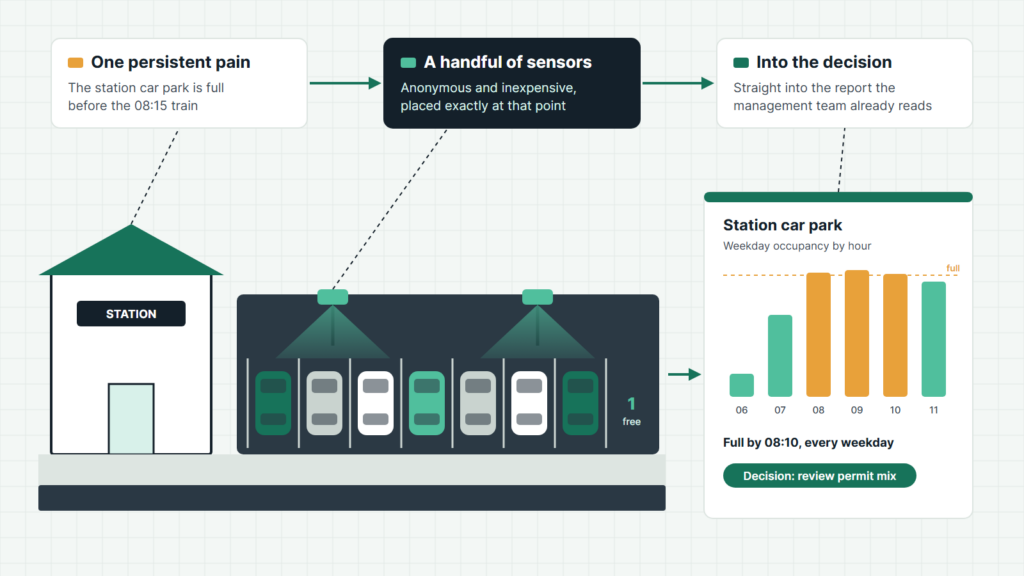
- Start with one persistent pain: car park occupancy at the rail station, crowding at the school-run pinch point, interchange connection failures at peak.
- Deploy targeted, anonymous, inexpensive sensing exactly at that point — a handful of devices, not an estate.
- Engineer the data directly into the decision instrument: the report to the management team, the NTA or TII submission, the council paper.
- Let the answer fund the next question. Occupancy data justifies enforcement changes; interchange data justifies timetable engagement with operators; car park data underwrites the case for expanded provision.
The compounding effect is the story. Each instrumented question produces a decision and its evidence — the sensing layer, the standard data model, the reporting routine — so the authority gets stronger per pound spent than a big city achieving a comparable unit of insight.
This is also, incidentally, the strategic argument we make to small and mid-sized operators of all kinds — FM, retail, transport: analytics is not a scale threshold but an engineering discipline, and disciplined beats big every time you compete on decisions.
Denizon builds right-sized sensing and analytics for mid-sized authorities and operators. Talk to us about the one question worth instrumenting first.
CrowdSense counts people and monitors indoor conditions across public and commercial spaces — anonymously, on Cisco Meraki Wi-Fi, cameras and sensors you may already own. Talk to our team about measuring a site or a portfolio.