
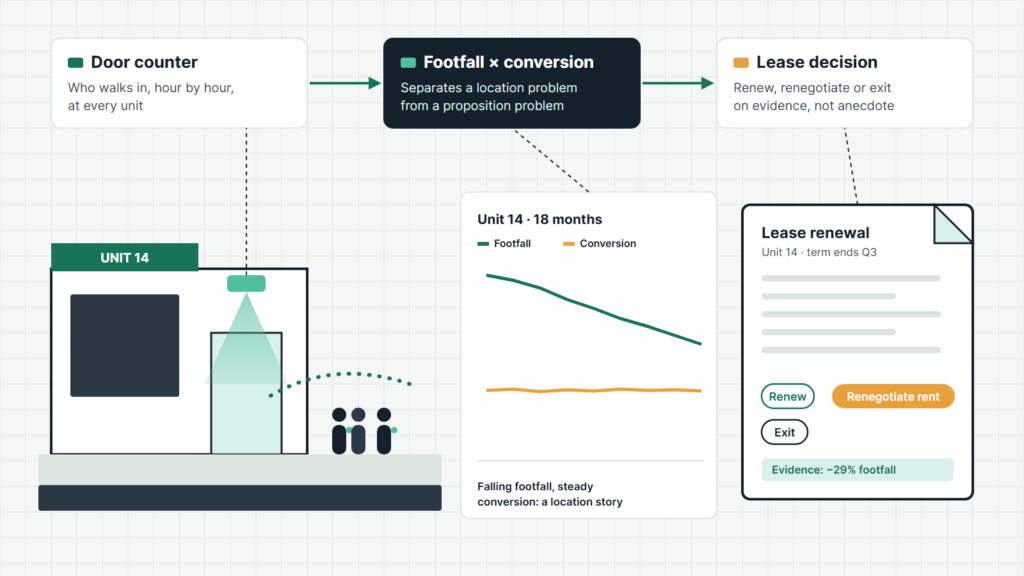
Lease decisions — renew, renegotiate, relocate, close — are among the largest financial commitments a retailer makes, and they’re typically argued from one input: sales history. Sales alone cannot distinguish between very different diagnoses.
What sales hides, footfall reveals
Consider two stores, both with declining takings:
- Falling footfall, stable conversion is a location or catchment story: accessibility, competition, anchor changes in the centre. The response is marketing, landlord negotiation or exit, and the decision data is a trend line running years back.
- Stable footfall, falling conversion is an internal story: proposition, pricing, merchandising, staffing — the store is getting the audience and failing to convert it. Exit would be a mistake; the fix is operational, and far cheaper.
Same sales chart, opposite decisions, and a plausible eight-figure difference in outcome across a portfolio. Yet most chains own no footfall series for most of their estate, so the distinction never gets drawn.
Building the decision dataset
Anonymous, continuous doorway sensing per store creates the missing series. The analytical payoffs appear quickly:
- Leases renewed or exited with evidence rather than negotiation about anecdote.
- Refit and refurbishment cases argued from measured before-and-after dwell and flow, not design-agency rhetoric.
- Marketing held to an in-store uplift standard, grounding ad spend in physical response.
- Rent negotiations with landlords and centres put on a shared evidence base: measured traffic is a language centres already speak. (This connects the standalone store to the analytics game shopping centres have always played, the subject of a follow-up piece.)
The stores that close wrongly are usually the ones nobody could diagnose. Sensing is cheap relative to one year’s rent on one mistaken lease. The reporting guide shows how the trend and exception views are produced.
CrowdSense provides per-store footfall, dwell and flow analytics, anonymously and continuously. Talk to Denizon about instrumenting a lease-renewal cohort.
CrowdSense counts people and monitors indoor conditions across public and commercial spaces — anonymously, on Cisco Meraki Wi-Fi, cameras and sensors you may already own. Talk to our team about measuring a site or a portfolio.